

Most staffing and recruiting firms measure the efficacy of their AI tools the same way they measure any operational change: time saved, volume of resumes screened, reduced cost per hire. Those metrics are easy to pull together and straightforward to present.
The problem is that, on their own, they often answer the wrong question.
Efficiency metrics tell you how the process is running, but they don’t tell you whether it’s producing better outcomes. An AI tool that shortlists faster while narrowing the candidate pool simply accelerates a flawed process.
For agency owners and leaders, the metrics that matter are the ones that determine whether you win repeat business, protect fee integrity, and grow revenue per head. These are quality and business metrics, and any AI-based ATS/CRM should be actively improving all of them.
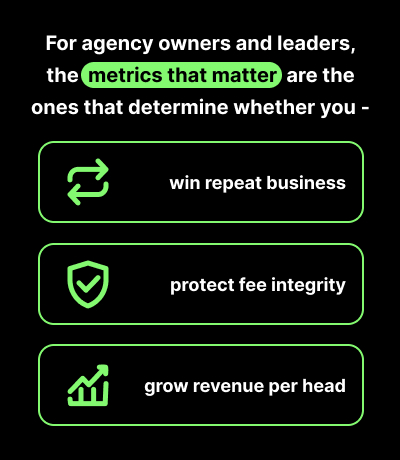
The three metrics that matter
Most KPIs in staffing and recruiting feed into three main outcomes. If AI is truly operating as intended, these three metrics should be moving in the right direction.
Search completion rate
This is the foundation. Are you delivering on the searches you take on? A high completion rate signals that your process, including your AI-assisted sourcing and screening, is reliably surfacing candidates who make it to placement.
A declining rate, or one that’s propped up by extended timelines, tells a different story.
The sub-metrics that feed this are:
- Time-to-shortlist: how quickly a credible slate reaches the client
- Shortlist quality: a measure of how well the candidates surfaced match the role requirements, typically assessed by interview progression rate or hiring manager ratings
- Shortlist-to-interview ratio: the proportion of shortlisted candidates who progress to interview
- Pipeline strength: the depth of qualified candidates available to keep a search moving toward placement
Industry benchmarks provide a useful baseline here. OneUp’s State of Recruitment report, based on data from over 200 contingency search firms, found that it took an average of three resumes submitted to book one first interview, and just under eight first interviews to fill one placement.
If AI is genuinely improving match quality, two metrics should improve in parallel: time-to-shortlist should decrease while candidate-to-interview conversion rates rise. Faster shortlists without a simultaneous improvement in conversion means you’re only sourcing more efficiently rather than matching more accurately.
Offer acceptance rate
When you reach the finish line, are you closing? Offer acceptance is a measure of how well you’ve understood the candidate, the client, and the fit between them. It’s also one of the areas where AI has the highest potential to help, as well as the most potential to cause damage if misused.
The sub-metrics here are:
- Interview-to-offer ratio: the proportion of interviewed candidates who receive an offer, reflecting how well the interview process is identifying genuinely placeable candidates
- Candidate qualification depth: a measure of how rigorously candidates have been assessed for role fit prior to submission
A recruiter who uses AI to screen faster but submits candidates without the depth of qualification needed to close will see this metric suffer.
AI should be improving the quality of intelligence that reaches the candidate conversation: the motivations, the fit signals, the potential objections. Not replacing the conversation itself. The offer stage is where human judgment earns its place, and the data should reflect that.
Client repeat rate
This is the business metric that delivers real value. Repeat clients are more efficient to serve, less price-sensitive, and far more valuable over time than over-relying on a continuous flow of new customer acquisition.
The sub-metrics are:
- Stick rate: placements that hold through the guaranteed performance period
- Fee leakage: client pushback on fees, replacements, and refunds
- Time-to-fill: the number of days it takes to fill a vacancy, from creation to offer
Fee leakage in particular is often the direct result of weak placement alignment. Firms that track it carefully often find it concentrates in a small number of roles or clients, pointing to systemic matching failures rather than one-off errors.
If AI adoption isn’t reducing fee leakage over time, it isn’t operating on the right part of the problem. The same logic applies to the stick rate: a placement that fails within the guarantee period is an expensive outcome regardless of how efficiently the search was run.
The business impact
Alongside the three core outcomes, two parallel, downstream metrics give the full picture of operational and business performance.
Revenue per recruiter
If AI is delivering genuine value, recruiters should be completing more searches, submitting stronger candidates, and closing more placements in the same timeframe. Revenue per recruiter is the number that makes that visible.
Time saved only converts to revenue if it translates into more completions. A recruiter who saves two hours a week on screening but fills the same number of roles isn’t generating more revenue. Revenue per recruiter is the metric that tells you whether the efficiency gain is real.
Search profit margin
That said, revenue is only part of the picture. The cost of extended searches, replacements, and recruiter time absorbed by poor-quality pipelines all affect margin.
AI that improves search quality should also improve the margin on each search, with fewer extended cycles, fewer replacements, and less rework. Together, revenue per recruiter and search profit margin provide the P&L frame that connects AI investment to the health of the business.
Tying AI to outcomes, not just inputs
The reason most firms can’t answer whether their AI is working is that they’ve measured it at the point of input rather than the point of outcome.
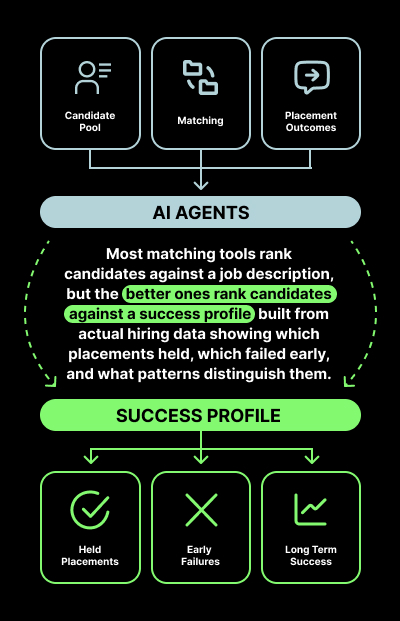
Predictive matching is the clearest example. Most matching tools rank candidates against a job description, but the better ones rank candidates against a success profile built from actual hiring data showing which placements held, which failed early, and what patterns distinguish them.
The performance gap between firms that use AI this way and those that don’t is significant and widening.
Measuring whether that distinction is working requires tracking what happens downstream. Do highly ranked candidates progress to offer at higher rates? Do they stick? Do they generate repeat business? If the model can’t be connected to those outcomes, it’s pattern-matching against inputs rather than predicting actual success.
Firms that feed real placement outcomes back into their matching model see shortlist quality, completion rates, and client retention improve over time. Those that treat AI as a one-directional input never capture that value.
A practical starting point
Most firms don’t need to measure everything at once. A practical approach is to start with two metrics: one from the search completion cluster and one business outcome.
A sensible pairing for most firms:
- Shortlist-to-interview ratio: a direct read on matching quality, with industry benchmarks available to compare against
- Stick rate: a direct indication of placement quality and client satisfaction
Establish baselines before AI tools are introduced or recalibrated. Track quarterly. If neither metric improves within two or three cycles, examine whether AI is being used on the right part of the problem.
Firms that measure AI against placement outcomes rather than workflow activity will build stronger client relationships, protect margins, and outperform firms still optimizing for speed alone.