
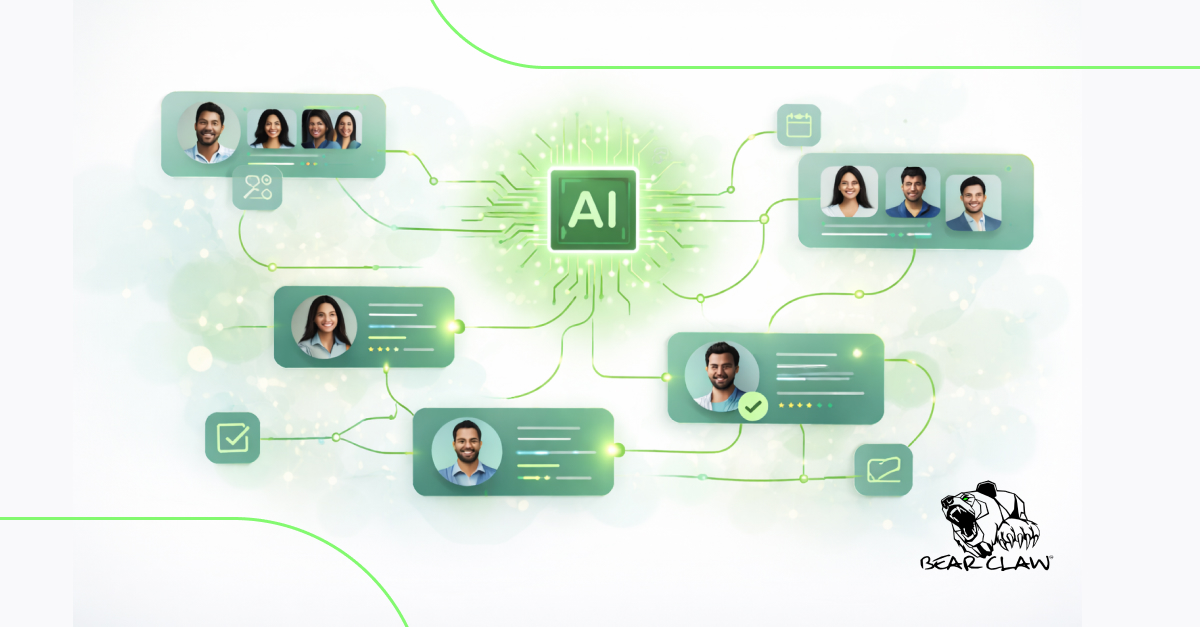
Artificial intelligence is now standard in most ATS platforms. Vendors compete on algorithm sophistication, number of integrations, and how many tasks they can automate. For buyers, the question has shifted from whether a platform uses AI to how much AI it includes.
That framing creates a problem.
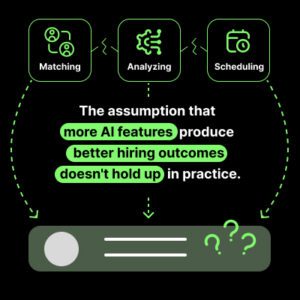
The assumption that more AI features produce better hiring outcomes doesn’t hold up in practice. And the data reflects it. According to IDC’s State of TA Tech 2025 report, only one in five large employers has achieved end-to-end AI orchestration from sourcing through to onboarding.
Most organizations have AI features. Very few have a system.
Isolated tools can optimize individual tasks. They can screen faster, schedule automatically, and surface more candidates. But optimizing tasks is not the same as improving outcomes.
Hiring is not a collection of individual steps. It’s a connected decision-making process. Without orchestration, more AI doesn’t make that process better. It just makes it faster.
When AI tools don’t talk to each other
Most AI in recruitment today is additive. A screening tool is layered onto an ATS, a scheduling assistant plugged in via API, a matching algorithm applied to the top of the funnel. Each tool performs its function, but they operate in isolation without shared context or coordination.
The result is a fragmented workflow where decisions don’t connect:
- A candidate flagged as high potential in screening is ranked low by a separate matching model using different criteria.
- A scheduling tool advances a candidate before a recruiter has properly reviewed them.
Progress happens, but not always in the right direction.
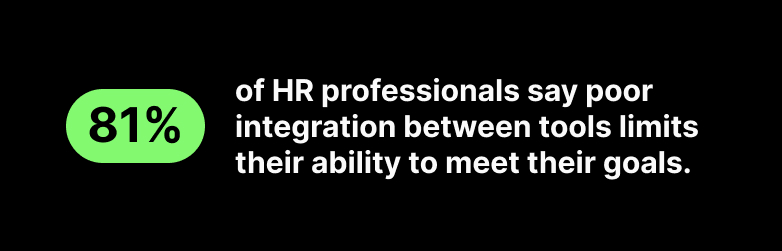
This fragmentation has a cost. HR.com’s 2025 State of HR Technology report found that 81% of HR professionals say poor integration between tools limits their ability to meet their goals, while 9 out of 10 organizations report that their HR systems don’t talk to each other.
This is the core limitation of bolt-on AI. It creates efficiency within silos while ignoring the connections between them. And those connections are where decisions are actually made.
In recruiting, it’s not the individual steps that determine outcomes. It’s how well those steps work together.
Feature intelligence versus system intelligence
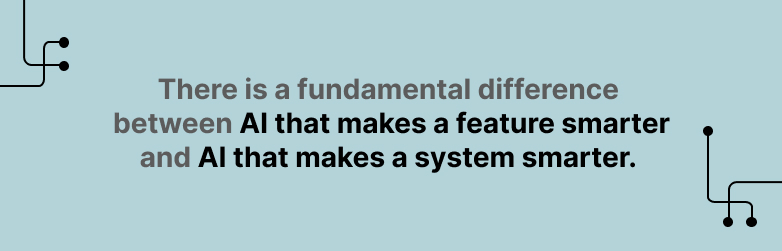
There is a fundamental difference between AI that makes a feature smarter and AI that makes a system smarter.
Feature-level intelligence improves individual tasks. Automating early-stage screening, for example, can cut time to fill significantly by removing manual bottlenecks. That is a meaningful operational gain.
But efficiency is not the same as better decisions.
System-level intelligence works differently. It coordinates AI across the entire hiring workflow, using data from every stage to inform the next. This is what agentic orchestration actually is: AI that doesn’t just respond to inputs but sequences, acts, and adapts across the workflow.
Screening informs matching. Historical placements inform shortlisting. Candidate engagement shapes outreach. Every step is connected, and the system learns continuously from the outcomes it produces.
Feature intelligence helps you process more candidates. System intelligence shapes which candidates reach hiring managers, sharpens recruiter confidence in every decision, and improves the success rate of those placements over time.
Making the process faster is useful, but making outcomes better is what really matters.
Why orchestration matters more than automation

Automation and orchestration are not the same thing and conflating them leads organizations to invest in the wrong areas.
Automation removes manual effort from repeatable tasks. It is valuable, necessary, and increasingly table stakes in modern recruitment. However, automation without orchestration is just a faster version of the same process. It accelerates candidates through the process, but it also erodes the quality of their experience and leads to less thoughtful evaluation at each stage.
Orchestration is control. It’s deciding which agent does what, when, and why. It ensures the right AI is applied at the right moment with the right data, while coordinating how work flows between agents and back to humans. Done well, it doesn’t replace judgment, it sharpens it and drives every step toward a clear outcome.
In practice, this means:
- AI-driven matching informed by real placement outcomes, not resume alignment.
- Candidate prioritization based on tenure and performance signals, not surface-level skills.
- Shortlists ranked by likelihood of success, not keyword fit.
This is what a connected hiring lifecycle looks like. Agentic orchestration is what makes it possible: a system where decisions compound across the entire workflow, each step making the next one smarter.
Where AI sits in the workflow matters
A simple way to tell whether a platform offers real orchestration is where AI shows up in the workflow.
In feature-based platforms, AI lives at the edges. It generates inputs at the start or reports at the end. A sourcing tool surfaces candidates, a dashboard shows analytics in between, and the recruiter is left making decisions without connected intelligence.
In an orchestrated system, AI is embedded throughout. It surfaces insight at the moment decisions are made, flags anomalies in real time, and continuously updates recommendations as new data comes in. Recruiters aren’t working around AI or reviewing it after the fact. They’re operating within a system where AI and human judgment move together.
This matters because recruitment is not linear. Priorities shift, candidates behave unpredictably, and roles evolve mid-process. Systems that rely on fixed inputs and static outputs break under that pressure. Systems that adapt, learning from outcomes and adjusting in real time, get stronger as they go.
Orchestration isn’t about adding AI to the workflow. It’s about making the workflow itself intelligent.
What AI in recruitment should be measured on
Efficiency tools and decision-impact tools are not the same, and investing in one does not deliver the benefits of the other. Most AI in recruiting focuses on speed, but speed alone does not improve outcomes.
The biggest gains come from applying intelligence at the points where decisions are made, in matching, prioritization, and in the quality of information available to recruiters at critical moments. That is what intelligent orchestration looks like in practice. Not isolated features, but a system designed to influence outcomes across the entire workflow.
The goal is not faster hiring. It is better hiring.
Because if hiring decisions don’t improve, nothing else will.