
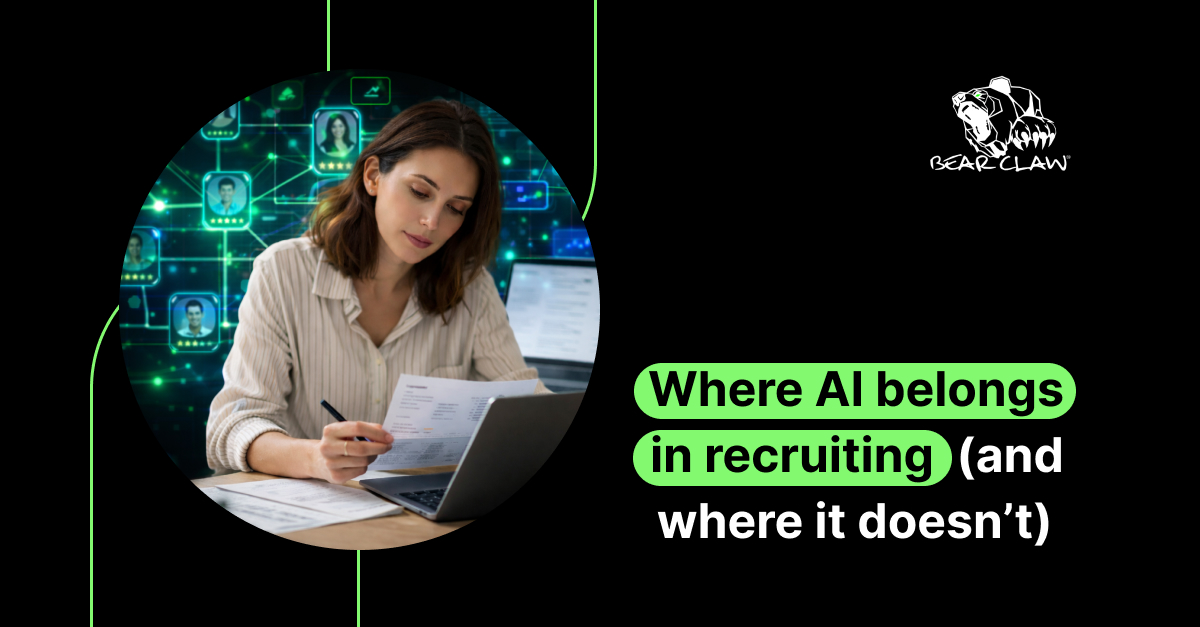
Artificial intelligence is now firmly embedded in recruitment. From sourcing and screening to scheduling and analytics, AI tools are being adopted across talent teams of all sizes.
According to research compiled by Second Talent, around two-thirds of organizations are now using AI in recruitment in some form, with the highest adoption among larger employers and fast-growing businesses.
Gartner research has identified mistrust of AI from candidates looking for roles, with only 26% feeling confident that AI recruitment tools will judge them fairly. This also impacts how candidates view potential employers, with 25% saying the use of AI would reduce trust.
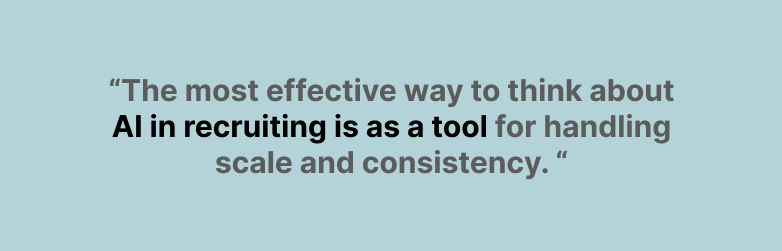
On the flipside, 4 in 10 candidates are using AI for their applications, whether on resumes, cover letters, or to generate writing samples for applications.
The one certainty is that AI has become part of the recruitment process, on both sides. The real question is what AI should actually be responsible for, and just as critically, what it should not.
A practical rule for using AI in recruiting
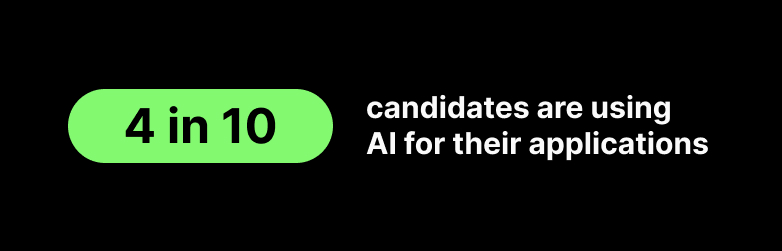
The most effective way to think about AI in recruiting is as a tool for handling scale and consistency. AI excels at processing large volumes of information, spotting patterns, and executing rules repeatedly without fatigue. Humans aren’t always as good at this.
This distinction matters because adopting AI is not the same as defining how it should be used. Many recruitment teams introduce AI tools without a clear framework for how automation and human judgment should interact.
Aptitude Research found that, while more than 60 percent of companies say they use AI in talent acquisition, only around 40 percent report high trust in AI recommendations, and most insist on human oversight for final decisions.
That caution is not a failure of adoption. It’s a sensible recognition of the importance of the human element in recruitment.
The risk is not human oversight; it’s treating AI as a decision-maker rather than a decision support system. Without an explicit operating principle, teams can end up relying on AI in some moments, overriding it in others, and never clearly defining where judgment must remain non-negotiable.
AI should support decisions, not replace accountability. Recruiters are taking huge risks by treating AI as a decision-maker rather than a decision support system.
What AI should automate in recruiting
Recruiters should automate everything that is repetitive, data heavy, and pattern driven, while intentionally preserving critical human judgment moments that determine trust, motivation, and successful closes.
There are several areas in recruiting where automation is not only appropriate but necessary. These tasks tend to be operational, repetitive, and heavily data driven.
Sourcing and market scanning
AI can scan large talent pools across ATS platforms, professional networks, and internal databases far faster than a human recruiter can. It can surface candidates based on skills, experience patterns, and historical success data, allowing recruiters to focus on outreach and engagement rather than manual searching.
Deloitte’s State of AI in the Enterprise research shows that HR and talent acquisition teams are among the fastest adopters of AI, with sourcing, resume screening, and talent market analysis emerging as some of the most common and mature use cases. This reflects where AI delivers the most immediate value in recruitment.
Resume screening and early-stage filtering
Screening is one of the most time-consuming parts of recruiting. AI can reliably handle initial filtering by applying consistent criteria at scale. When done responsibly, this removes early bottlenecks without replacing human judgment later in the process.
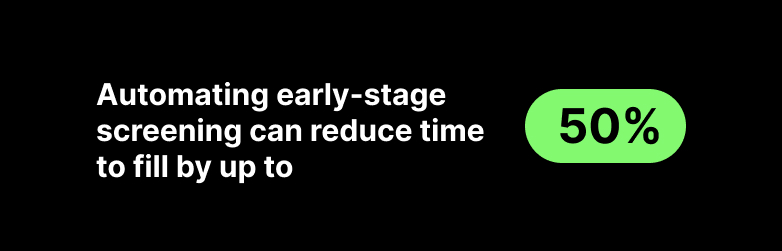
By analyzing ATS data, LinkedIn profiles, and historical hiring outcomes at scale, AI can identify skill and success patterns far faster and more consistently than a human recruiter. Removing manual filtering and early-stage bottlenecks in this way can significantly reduce time to fill, in some cases by up to 50%, while allowing recruiters to focus their attention on candidate quality rather than processing volume.
Scheduling and coordination
Interview scheduling, rescheduling, and follow-ups are classic examples of low-value work that still consume significant recruiter time. Automation in this area improves both recruiter productivity and candidate experience.
Predictive matching and analytics
AI can analyze historical hiring data, tenure patterns, and performance signals to identify candidates statistically more likely to succeed in a given environment. Used correctly, this improves slate quality and reduces wasted interviews.
Importantly, this data should inform decisions, not dictate them.
Where AI should assist but not decide
Some recruiting activities benefit from AI input but still require human interpretation.
Shortlisting and candidate prioritization sit firmly in this category. AI can surface ranked candidate lists based on defined criteria, but recruiters must contextualize those recommendations. Business priorities shift, teams evolve, and no dataset fully captures real-world nuance.
The same applies to role calibration and success profiling. AI can highlight patterns from past hires, but recruiters must decide which signals still matter and which reflect outdated assumptions.
AI helps surface patterns humans might miss, but recruiters still own judgment, accountability, and exceptions.
This human oversight is what prevents automation in recruitment from becoming rigid or exclusionary.
Where human judgment remains non-negotiable
There are aspects of recruiting where AI should not be in control at all. These moments are defined by trust, empathy, and persuasion rather than data processing.
- Live conversations and relationship building. Recruiting is fundamentally interpersonal. Interviews are not just about answers but about tone, curiosity, and connection. AI cannot replicate the rapport built through real conversation.
- Motivation and intent discovery. Understanding why a candidate wants a role, what they are optimizing for, and how their goals align with the organization requires listening and adaptability.
- Cultural alignment and team dynamics. AI can infer patterns but cannot observe interpersonal chemistry or values alignment. Experienced recruiters regularly override technically strong matches that would fail culturally.
- Offer negotiation and closing. Negotiation is not transactional. It involves reassurance, compromise, and long-term relationship thinking. Automation here risks alienating candidates at the most sensitive stage of the process.
- Non-linear and complex career paths. Human judgment helps to surface candidates with non-linear or complex career paths, perhaps due to personal circumstances or career pivots. Human interpretation is needed here, as AI systems tend to penalize these edge cases.
Overriding automated signals in these situations helps prevent bias amplification and supports fair, holistic hiring decisions. In these moments, AI can inform judgment, but it cannot replace it.
The risks of over-relying on automation
When organizations over-automate recruiting, they often mistake efficiency for effectiveness.
One major risk is bias amplification. AI systems trained on historical hiring data can reinforce existing inequalities if those patterns are not actively audited. This risk is well documented in research on AI in hiring.
There is also a candidate experience risk. Over-automated processes can feel impersonal and opaque, reducing engagement and acceptance rates. Transparency about how AI is used is essential.
Finally, treating AI outputs as truth rather than input weakens recruiter capability over time. When humans stop challenging recommendations, they lose the ability to spot edge cases and make informed exceptions.
Using AI to strengthen recruiters
The most effective recruiting teams use AI intentionally. Automation handles scale, consistency, and operational load. Recruiters retain ownership of relationships, judgment, and outcomes.
This approach delivers measurable benefits. Recruiters spend less time on administration. Candidates receive faster responses. Hiring managers see stronger shortlists. Over time, better matches improve retention and performance.
The safest and most effective approach is intentional orchestration. AI should handle the workload so recruiters can focus on the human interactions that actually close great hires.
Conclusion
AI is now a permanent part of recruitment. The question is no longer whether teams should use it, but how deliberately they do so.
Used well, AI removes friction from the recruiting process. It handles the volume, repetition, and pattern detection that slows teams down, while giving recruiters better information to work with.
What should not be automated is the point at which persuasion, nuance, and relationship building matter most. Live conversations, motivation discovery, offer negotiation, and trust building require empathy, context, and adaptability.
The most effective recruitment teams draw clear boundaries. They automate operational work. They use AI to assist with insight and prioritization. And they retain full human control over moments where trust, motivation, and persuasion matter most.
Recruiting has always been a human discipline, and AI does not change that. It simply raises the bar for how intentionally human judgment is applied.