

Far too often, companies invest in new recruiting technology to solve old recruiting problems. The tools change. The dashboards get prettier. The workflows get faster.
But one problem has survived every wave of recruiting innovation, including AI: nobody really owns the outcome of a corporate hire.
Faster hiring is easy to measure. Better hiring is what actually matters. Most recruiting technology has spent a decade optimizing process efficiency, with faster screening, shorter time to fill, and lower cost per hire. Those are real improvements. But they measure how quickly candidates move through the funnel, not whether the right ones end up in the role. AI, deployed the same way, produces the same result at greater speed.
The future of recruiting belongs to organizations that can prove their hires stay longer, perform better, and create more value after they join. Most aren’t measuring that yet. And the reason goes deeper than technology.
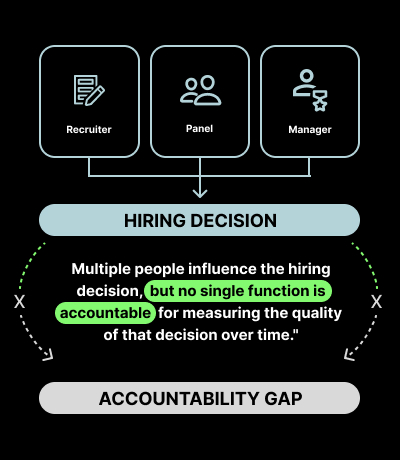
When a corporate recruiter submits candidates to a hiring manager, their job is largely done. The hiring manager makes the final call. If the hire works out, the hiring manager gets credit. If it doesn’t, the recruiter wasn’t responsible for the decision, and the hiring manager wasn’t close enough to the sourcing process to know whether the right people were even in the room.
Multiple people influence the hiring decision, but no single function is accountable for measuring the quality of that decision over time.
When AI is introduced into this dynamic, it does what it’s asked to do: screens faster, scores resumes, schedules interviews, and reduces time to fill. The process speeds up. The accountability gap stays exactly where it was.
Nobody owns the outcome
The gap between submission and decision is where the most important judgment calls get dropped.
Cultural fit, team dynamics, remote working aptitude, and professional presence aren’t things a resume or an AI screening score surfaces reliably. These are the things that a good recruiter probes for in conversation, and that a hiring manager typically discovers once the person is in the role.
BLS data from January 2024 shows that at any given time, around one in five workers has been with their current employer for a year or less. Most of that cost traces back to a hiring decision, and most hiring decisions trace back to a process that nobody is formally scoring.
In an agency context, the recruiter has a financial stake in getting this right. Their fee depends on the placement holding, so they check in, follow up, and track whether the candidate is still in the role because it affects them directly.
The corporate recruiter does not have an equivalent incentive. They’re measured on how quickly they fill roles and how many they process. Whether those hires are still in the building eighteen months later is, structurally, someone else’s problem. This is simply how the system often operates, not a criticism of the people working in it.
Why current metrics are misleading
The financial case for fixing this is straightforward, even if most organizations aren’t looking at it directly.
Every hire carries a cost: job posting, recruiter time, interviews, background checks, onboarding, and training.
SHRM’s research consistently shows that when a hire doesn’t work out, those costs are multiplied. The total cost of replacing an employee runs well into the tens of thousands for mid-level roles and significantly higher for senior ones, once lost productivity and the expense of starting the search again are factored in.
Early turnover is where this hits the hardest. A meaningful share of departures happens within the first year, and this is often before the new employee has had time to contribute enough to justify what was spent acquiring them.
In most corporations, that cost sits somewhere in the general ledger, absorbed into HR budgets and rarely connected back to the hiring decision that caused it. Consider how the same organization treats its other supplier relationships. Procurement teams score vendors on delivery rates, defect rates, and return rates. A supplier with a 30% failure rate would be reviewed, challenged, or replaced. The recruiting function, internal or external, rarely faces the same scrutiny. The data that would enable it exists in the same financial systems. Nobody has been asked to look at it that way.
That’s the core problem. Most organizations review this data after the fact, once the money is already spent. The insight exists in the financial data, but it’s not being looked at in the right way, at the right time.
The data already exists
Most of the information needed to measure recruiting outcomes properly already exists inside the business.
Payroll systems know who’s still employed. Performance management tools track who’s meeting their KPIs. Finance knows what each hire costs, including onboarding, training, and any sign-on or relocation spend. HR systems hold tenure data going back years.
What most corporations don’t have is anything connecting those data points back to the original hiring decision. Who sourced this person? Who screened them? Which hiring manager requested them? Did the people who scored highest in screening actually perform better in year one?
That connection is where AI has genuine value in corporate recruiting, by closing the loop between hire and outcome rather than just automating the top of the funnel.
What should be measured
The metrics that matter in corporate recruiting are further downstream than most teams are currently looking.
Time to fill measures speed, and cost per hire measures spend, but neither tells you whether the hire was successful. The metrics worth tracking are:
First-year retention by hiring manager. If one department consistently loses new hires within twelve months, that’s worth investigating, whether it points to a sourcing problem, a screening problem, or a management problem.
Given that a third of all turnover happens in year one, this number alone tells you a lot about where the system is breaking down.
Post-hire performance against role KPIs. Did the people hired actually do the job they were hired to do? This data exists in performance review systems and almost never gets connected back to the recruiter or the sourcing channel.
Average tenure by source. Are hires from certain sourcing channels, recruiters, or role types staying longer than others? Patterns in tenure data are one of the clearest signals of matching quality available, and one of the least used.
Cost per hire adjusted for attrition. A hire that costs $5,000 and leaves in four months is not the same as a hire that costs $8,000 and stays for four years. Blending those into a single cost-per-hire figure obscures what’s happening and makes it harder to argue for investment in better matching tools.
None of these require new data, simply the will and the process to connect the data in a meaningful way.
Why AI is uniquely suited to solve this problem
The conversation about AI in corporate recruiting tends to focus on the front end: sourcing tools, resume screening, interview scheduling. These are real efficiency gains and a reasonable place to start.
The harder and more valuable application is at the back end: tracking what happens after the hire, identifying patterns in who stays and who doesn’t, and feeding those patterns back into how candidates are screened and selected in the first place.
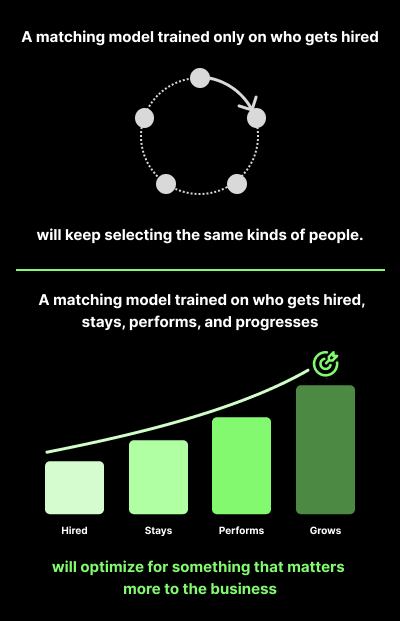
A matching model trained only on who gets hired will keep selecting the same kinds of people. A matching model trained on who gets hired, stays, performs, and progresses will optimize for something that matters more to the business. The gap between those two models is significant, but many corporate recruiting functions are running on the former.
The same logic applies to how corporations evaluate their external recruiting partners. In manufacturing and retail, vendor scorecards are standard practice, and suppliers are scored on delivery, quality, and return rates. The data needed to score a recruiting firm on stick rate, cost per retained placement, and average tenure is sitting in the same systems. It just isn’t being used properly.
What happens next
Used correctly, AI makes the accountability gap visible. And visible problems can be addressed.
The recruiter who knows their first-year retention rate by hiring manager will have different conversations than one who doesn’t. The corporate recruiter who can show that certain sourcing channels produce hires with twice the average tenure will make different decisions about where to invest. The hiring manager who sees their own attrition data will engage differently with the screening process.
The organizations that get this right won’t just be faster at hiring. They’ll be better at it, and they’ll be able to prove it. That’s the shift worth making, and it starts with deciding that better hiring is worth measuring.